/ home
MENU

This article addresses common issues faced by CMS users and how to resolve them.
.jpeg)
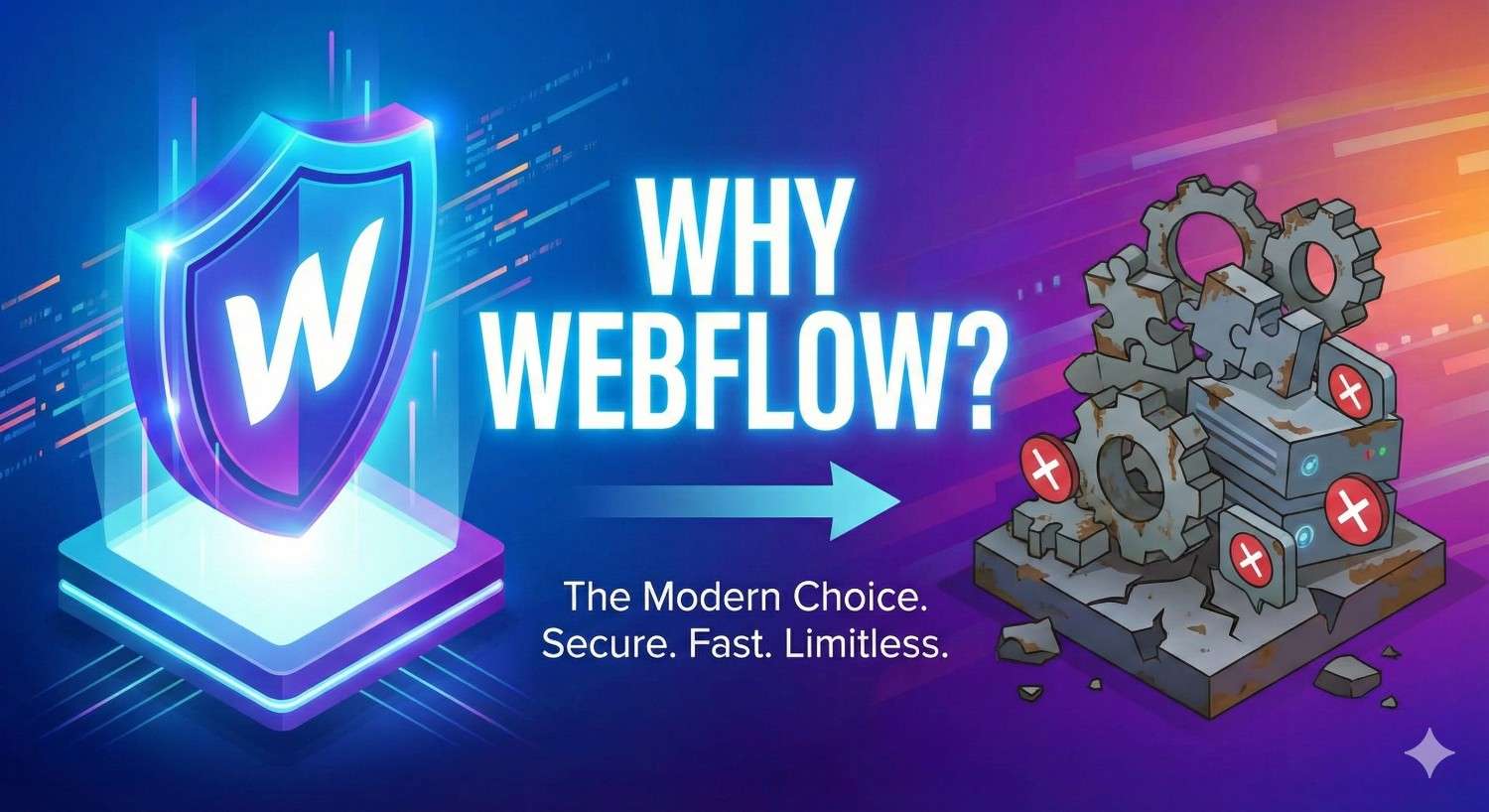
For the last two decades, the internet has been built on a specific set of rules. You buy a domain, you install a Content Management System (CMS) like WordPress, you pick a template, and then you spend the next five years praying that a plugin update doesn't crash your entire business.
It was the standard because it was the only option. But the web has evolved.
Today’s startup founders, marketing directors, and business owners face a new set of challenges. Speed is non-negotiable. Design needs to be bespoke, not cookie-cutter. Security threats are smarter. And frankly, nobody has time to manage server updates on a Tuesday night.
Webflow is more than just a website builder. It changes the way websites are created by combining the power of custom code with easy visual editing, bringing designers and developers together on one platform.
In this article, we’ll break down the old approach to website building. You’ll learn why Webflow is a better choice than traditional CMS platforms in 2026, and how using outdated systems could be costing you more than just hosting fees.
To understand why Webflow is different, we first need to look at what we are comparing it to.
A Traditional CMS—think WordPress, Joomla, or Drupal—is software that allows you to create, manage, and modify content on a website without needing specialized technical knowledge.2
These platforms use a connected setup where the backend (content management) and frontend (what users see) are closely tied together. They depend on themes for design and plugins to add features.
If you have run a business website on a traditional CMS, you likely know the struggle:
Webflow is often described as a "visual development platform."6
Unlike Wix or Squarespace, which are drag-and-drop builders for consumers, Webflow is a professional tool.7 It writes clean, semantic HTML, CSS, and JavaScript for you as you design visually.
It is a SaaS (Software as a Service) platform, meaning it is an all-in-one solution.9 You don't buy hosting separately; you don't install software; you don't manage security patches. It is all handled by Webflow’s enterprise-grade infrastructure.
Webflow is built for serious businesses.10 It is the platform of choice for:
When we analyze Webflow vs traditional CMS options, the decision usually comes down to six critical factors.
With a traditional CMS, you are usually fighting the theme. You have a vision in your head, but the template only allows a sidebar on the right, not the left. To change it, you need to dive into PHP files.
Webflow offers 100% design freedom. It is a blank canvas. If you can design it, you can build it. You aren’t dragging pre-made blocks; you are manipulating raw HTML and CSS elements visually. This allows for bespoke, award-winning designs that stand out in a sea of generic templates.
This is where Webflow separates itself from other "builders." Most visual builders export "spaghetti code"—messy, bloated, and unreadable.
Webflow writes code as clean as if a senior developer hand-wrote it. This matters because:
In the Webflow vs WordPress debate, WordPress proponents often shout "Yoast!" But here is the reality: You don't need a plugin to do SEO correctly.
Webflow gives you native control over every SEO lever without extra software:
Because Webflow sites are lighter and faster, they inherently score better on Core Web Vitals, a major Google ranking factor.
Traditional CMS platforms are often slow because they rely on PHP (server-side processing) and databases that get clogged with plugin data.15
Webflow hosting is powered by Amazon Web Services (AWS) and a global Content Delivery Network (CDN) (Fastly).16
This is a massive selling point for enterprise clients. With a traditional CMS, you are the security guard. If you forget to update a plugin, your site gets hacked.
With Webflow, security is their problem, not yours.
In Webflow, the core features you need (forms, sliders, tabs, interactions, CMS) are built-in. You don't need a "slider plugin" that slows down your site.
If you need advanced functionality (like a complex filter or specific integration), you use Integrations or custom code, not plugins. This keeps the ecosystem clean and prevents conflicts that crash sites.
Let’s look at a direct comparison to see the Webflow CMS benefits clearly.
Comparison tables can be boring. Instead, let’s look at what using these platforms actually feels like day-to-day. Here is the real difference between using a traditional platform (like WordPress) and using Webflow.
With a traditional CMS, you usually start by buying a "Theme." It looks great in the preview, but the moment you try to change something—like moving a button or changing the menu layout—you get stuck. You are fighting against the theme's rules. To fix it, you usually have to hire a developer to rewrite the code.
Webflow is different. There are no rigid rules. You start with a blank canvas. It gives you the power to place elements exactly where you want them, down to the pixel. You don’t need to know how to code to get a custom look; the visual interface handles the hard work for you.
Think of a traditional CMS like a messy closet. Over time, as you install plugins and themes, the background code gets messy and heavy. This "bloat" makes your website load slowly, which frustrates visitors and Google.
Webflow is like a minimalist, organized closet. When you publish your site, Webflow writes super clean, tidy code—the same kind a high-level software engineer would write by hand. Because the code is so clean, browsers can read it instantly, making your site load lightning fast without you having to do anything extra.
This is the biggest pain point for business owners. On traditional platforms, you are the security guard. You have to constantly log in to update plugins and software. If you forget, your site might get hacked. If you click "update" and it conflicts with another plugin, your site might crash.
Webflow takes this burden off your shoulders. It is a "managed" platform. This means Webflow handles all the updates, security patches, and backups behind the scenes. You never have to worry about your site breaking because of an outdated plugin. It just works.
When you use a traditional CMS, you have to go out and rent a server (hosting) to put it on. Many businesses buy cheap hosting to save money, but this means if a lot of people visit your site at once, it might crash.
Webflow includes world-class hosting automatically. They use Amazon Web Services (AWS)—the same massive servers that power Netflix and fast-growing tech companies. Your site will stay online and fast whether you have 10 visitors or 10 million.
Traditional software (like WordPress) is technically free to download. But "free" is misleading. Once you pay for good hosting, buy premium plugins for security and SEO, and pay a developer to fix bugs, the costs add up quickly.
Webflow charges a monthly subscription, so the upfront cost looks higher. But that price includes everything: the hosting, the security, the editor, and the tools. In the long run, it is often cheaper because you aren't paying for emergency fixes or expensive add-ons.
Webflow isn't for everyone (we'll get to that in a moment), but it is the best CMS for modern websites in specific categories.
You need to move fast. You need a marketing site that looks like a million bucks but doesn't distract your engineering team. Webflow allows marketing teams to own the website.19 You can create new landing pages for campaigns in hours, not weeks, without pulling a developer off your product roadmap.20
For agencies, Webflow is a profit multiplier. You can build sites faster because you aren't fighting code. You can charge more because the design quality is higher. And most importantly, you stop getting 2 AM calls from clients saying, "I updated a plugin and the site is broken."
If your website is your primary sales channel, you need stability and speed. Webflow’s CMS allows content editors to write blog posts and case studies directly on the page (Visual Editor) without seeing the backend code.21 It’s intuitive and foolproof.
As an expert, I value honesty. Webflow is powerful, but it is not a magic wand for every single scenario.
While Webflow has "User Accounts," if you are building a massive social network or a platform with complex backend logic (like Airbnb), a traditional framework (Laravel, React) or a robust CMS like Drupal might be better.
Webflow E-commerce is great for small to medium stores.22 However, if you have 10,000 SKUs, complex multi-currency logic, and heavy inventory management needs, Shopify or Magento are still the kings of e-commerce.
Webflow is a hosted platform. You cannot host the CMS on your own private server in your basement. For 99% of businesses, this is a pro (security). For highly regulated industries requiring on-premise hosting, this is a con.
To prove the point, let’s look at how businesses are actually using Webflow.
A B2B software company used to wait two weeks for their dev team to code a landing page for a new eBook. After switching to Webflow, the marketing manager built the page herself in 4 hours. The result? They launched the campaign same-day and increased lead velocity by 300%.
A digital magazine migrated from WordPress to Webflow. On WordPress, their site crashed whenever a viral article hit. After moving to Webflow, they handled 100,000 visitors in an hour with zero downtime, and their "Time to First Byte" (speed) improved by 60%.
The internet is moving toward a No-Code / Low-Code future.
In the past, there was a strict wall: Developers coded, Designers designed. Webflow tears down that wall. It empowers visual thinkers to build powerful products.
The future of the web is about Performance, Experience, and Agility.
Choosing Webflow today is future-proofing your digital presence.
So, why choose Webflow over traditional CMS platforms?
Choose it because you are tired of maintenance mode. Choose it because you want your brand to look unique, not like a template. Choose it because you want a website that works for you, bringing in customers through superior SEO and speed, rather than working against you with security flaws and crashes.
Traditional CMS platforms had their time. They were the best option for a long time. But for modern, growth-focused businesses, the flexibility, security, and performance of Webflow make it the clear winner.
Ready to transform your digital presence?
Don't let an outdated CMS hold your business back. Whether you are migrating from WordPress or building from scratch, the move to Webflow is an investment in your future.
Contact our Webflow experts today for a consultation.
Explore Real Strategies, Trends, and Tips to Help Your Brand Grow.
.png)